

Alpaca Wool —
soft warmth you can believe in
about the fiber that has been quietly warming for six thousand years
High in the mountains of Peru and Bolivia, where the air is thin and the sky seems closer than usual, live alpacas. Quiet, gentle, with large dark eyes that seem to reflect the evening. They roam in small herds along the slopes of the Andes, eating grass, basking in the sun, and carrying the wool for which people have loved them since before there were cities, paper, or even an alphabet.
Alpaca wool is a special material. Textbooks are written about it, scientific papers are dedicated to it, it is compared to cashmere and elevated above sheep's wool. But if you put aside dry science and simply touch it, you immediately understand: it's not just wool. It's something closer to a cloud. To a warm breath. To the feeling that appears when you cover yourself with a blanket on a cold evening, and the world immediately becomes softer.
Where it comes from
Alpacas are shorn once a year – usually in spring, when the Andes warm up. One animal yields two to four kilograms of wool. This is not much: for comparison, a sheep yields an average of five to seven kilograms at a time. But alpaca wool is more valuable precisely because there is little of it, and because each fiber is special.
If you look at an alpaca fiber under a microscope, you can see that it is hollow inside. A tiny tube filled with air. This air is what makes the wool so warm – it prevents cold from entering and retains body heat. Sheep's wool is dense, without an air core, and therefore sheep's wool is heavier and provides less warmth than alpaca wool of the same thickness. Scientists have calculated that alpaca wool is about three times warmer than sheep's wool of the same weight.
Why it's not itchy
Many are familiar with the unpleasant sensation: you put on a sheep's wool sweater, and your skin itches. This is due to sheep's lanolin – a natural fatty substance secreted by sheep, which often causes irritation on sensitive skin. Especially on children's skin.
Alpaca wool contains almost no lanolin. And that's why it is considered hypoallergenic – meaning it is suitable even for those whose ordinary wool causes itching. On the fiber softness scale, alpaca wool stands alongside cashmere: the fiber thickness is only eighteen to twenty-five micrometers, while sheep's wool is twenty-five to thirty-five.
What's soft to the touch, is soft to the heart.
Where it gets so many colors
Nature has given alpacas twenty-two natural shades of wool – from pure white, through all shades of beige, ginger, gray, to almost black. This is the widest palette among all wool-producing animals. And that's why things can be made from it without using chemical dyes – simply by choosing the right natural shades.
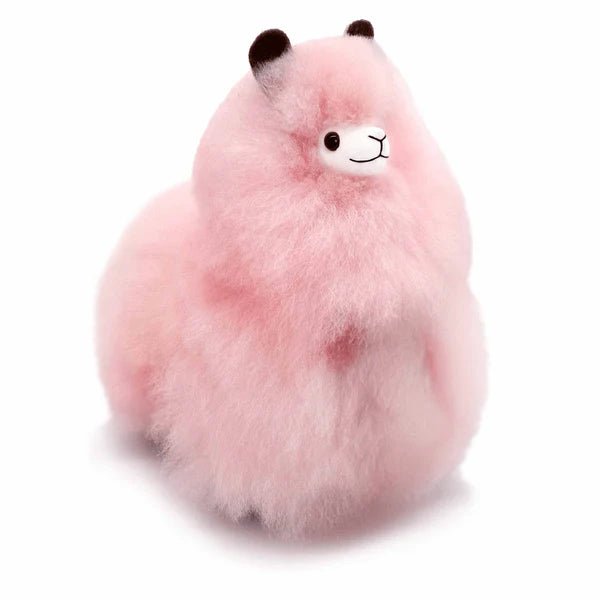
When we made our Fluffy alpacas, we wanted to preserve that very feeling – that the color comes from within, softly, without harshness. That's why even the brightest ones – Rainbow Alpaca, Monster Alpaca – are left fluffy, like clouds at sunset. Not glossy, not flat, not artificial. Warm.
Briefly about alpaca wool
- Natural fiber from the neck and back of an alpaca, native to the Andes
- Three times warmer than sheep's wool at the same weight
- Does not contain lanolin — hypoallergenic, does not cause itching
- Fiber thickness 18–25 micrometers — softer than sheep's, close to cashmere
- Available in 22 natural shades, without dyes
- Shearing — once a year, in spring, painless for the animal
Why it's perfect for children's toys
When a child picks up a toy, they don't evaluate it by its description. They feel it. With their skin, their cheek, their nose – all at once. And if the wool is itchy, if the smell is foreign, if the weight is wrong – the toy will stay on the shelf. But if it's soft, warm, and right – it will become a friend.
Alpaca wool gives that "right" feeling from the first touch. It doesn't static like synthetics. It doesn't smell of chemicals like cheap plush. It doesn't itch like sheep's wool. It's simply warm. And that's enough for a small hand to find its place in its softness and not want to let go.
We chose alpaca wool not because it's fashionable or expensive. But because we tried different materials and realized: nothing else gives the same feeling. When you hug an alpaca made of real wool, it feels like you're hugging a bit of the Andes themselves – their warm breath, their evening sun, their quiet peace.
And, perhaps, that's what we want to give to children. Not just a toy. But a piece of a world where everything is soft.
feel the softness yourself
See all alpacasFrequently Asked Questions
Is alpaca wool really hypoallergenic?
Yes. The hypoallergenicity of alpaca wool is confirmed by the almost complete absence of lanolin – the main allergen in sheep's wool. However, an individual reaction is possible to any material, so if a child has severe allergies, it is best to start with brief contact.
How does alpaca wool differ from ordinary plush?
Ordinary plush is polyester, synthetic. It's cheaper, but it can static, pills over time, and may smell of chemicals. Alpaca wool is a natural fiber: warm, breathable, does not accumulate static electricity, and does not lose its appearance over time.
Are alpacas shorn – is it painful?
No. Shearing an alpaca is similar to shearing a sheep and is done once a year with special shears. The animal is not hurt. On the contrary: by summer, the wool becomes heavy and hot, and shearing brings relief to the alpaca.
Is the alpaca wool in Fluffy toys real?
The outer layer of our alpacas is natural alpaca wool, which provides that feeling of a warm cloud. Inside is a soft hypoallergenic filler that holds its shape. All materials are certified for children's toys.
How long does a plush alpaca last?
With normal handling – for decades. Alpaca wool practically does not lose its appearance, and the filler does not clump. Many of our customers say: "Mashenka is twelve now, her alpaca has been with her since she was three, and it's still her favorite."
with warmth —
the Fluffy team